
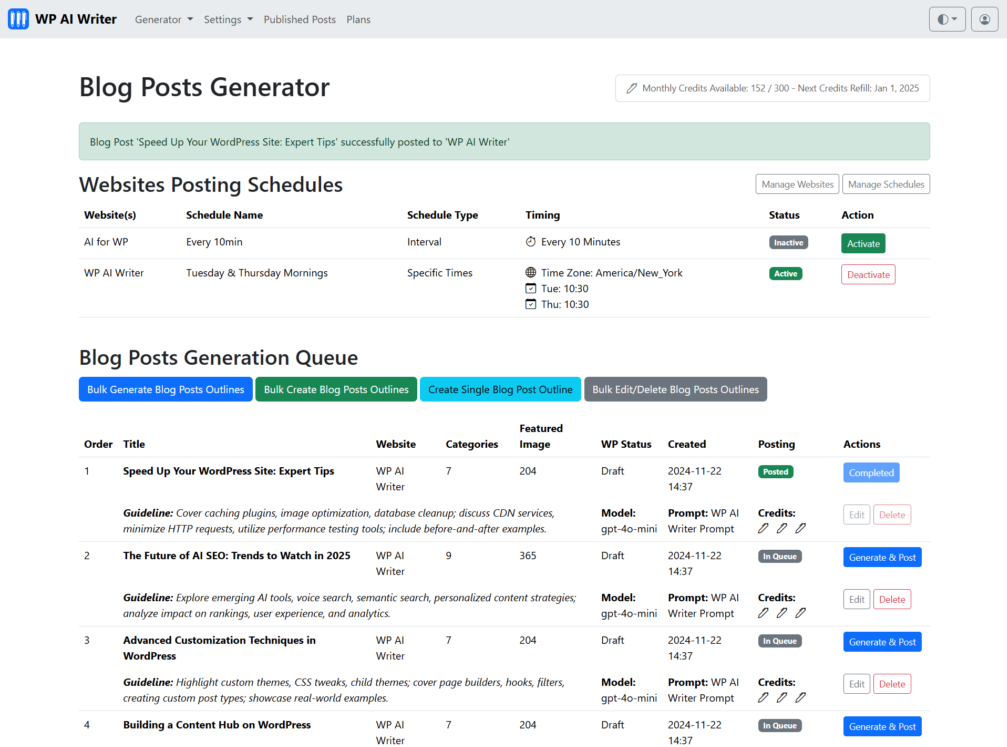
WP AI Writer was an AI content automation platform we built to generate, review, schedule, and publish content across WordPress websites.
It started from a simple idea: generating an article with AI is easy. Running a reliable content operation is not.
A production system needs much more than a prompt.
It needs inputs, queues, generation, quality controls, publishing rules, scheduling, CMS integrations, site-specific configuration, monitoring, and a way for humans to stay in control when necessary.

WP AI Writer was our attempt to automate that entire workflow.
Today, the standalone WP AI Writer product has been sunset.
But the technology, workflows, and lessons behind it continue to shape the AI systems we build at Ailephant.
What WP AI Writer automated
The core workflow connected several steps that would normally require repetitive manual work:
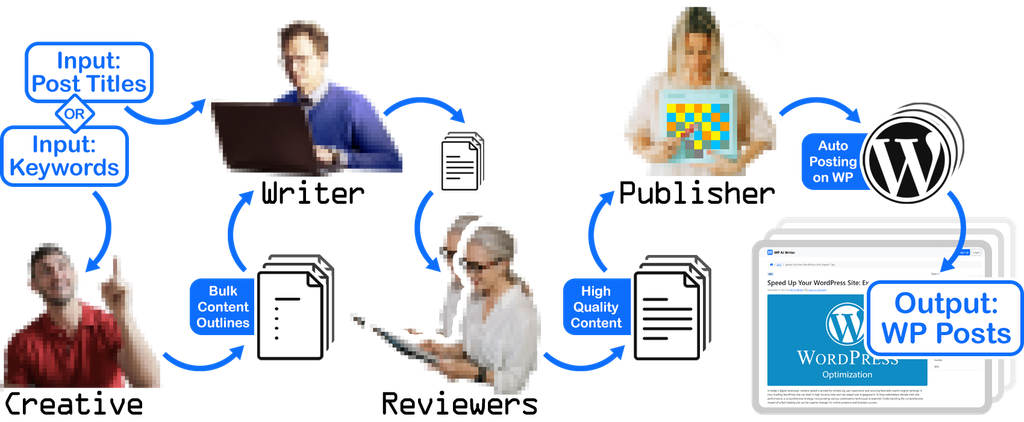
Content ideas and keywords → AI generation → automated review → publishing logic → WordPress → scheduled or published content
Instead of generating individual articles manually, users could create queues of content and let the system work through them automatically.
The platform was designed to support multiple WordPress websites, each with its own settings, subjects, language, publishing cadence, and content requirements.
Among other things, the system handled:
- AI-assisted article generation
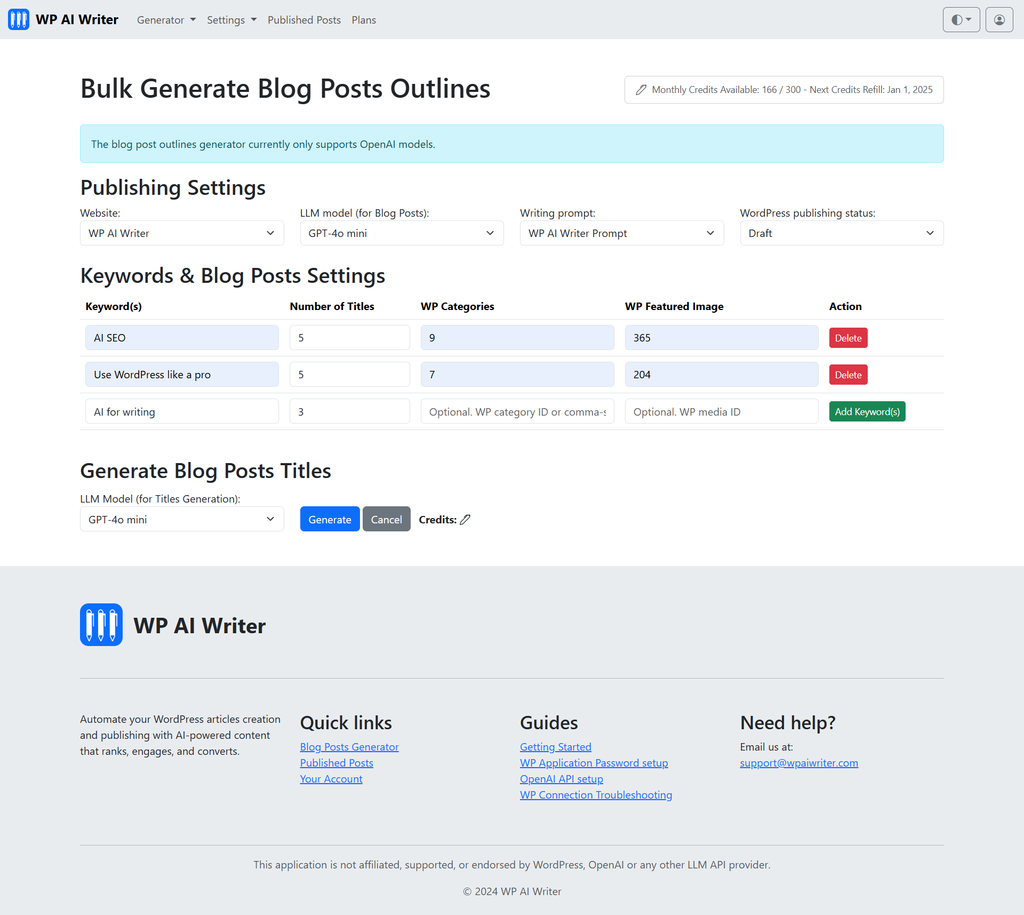
- Content queues and bulk processing
- Automated review agents
- WordPress publishing
- Categories, tags, slugs, and other publishing metadata
- Scheduled and recurring publishing
- Multiple websites from one system
- Site-specific prompts and configuration
- Different AI models and providers
- Draft, review, and publication workflows
The important part was not any individual feature.
It was the orchestration between them.
Generating text was the easy part
One of the clearest lessons from building WP AI Writer was that the language model itself is only a small part of a useful automation system.
A model can generate an article in seconds.
But a business workflow has to answer many more questions.
- What should be written?
- When should it run?
- Which website should receive it?
- Which model should be used?
- What instructions apply to this particular site?
- Does the output meet the required quality?
- Should another AI agent review it?
- Should a human approve it?
- How should it be formatted for WordPress?
- When should it be published?
- What happens when generation or publishing fails?
Those are orchestration problems rather than writing problems.
And they apply far beyond content.
AI agents become useful when they are part of a workflow
WP AI Writer increasingly moved toward an agent-based architecture.
One AI process could generate content. Another could review it against specific criteria. Additional logic could decide what happened next.
That created a pattern we now see across many business automation projects:
Trigger → context → AI agent → evaluation → action → next step
The action might be publishing an article.
But the same architecture can qualify a lead, analyze a document, prepare a report, update a CRM, process customer requests, or coordinate other AI agents.
The real opportunity is not simply giving businesses access to better models.
It is connecting those models to repeatable operations.
Automation does not create demand
WP AI Writer also taught us an important business lesson.
It is possible to build a system that works technically without building a product that deserves to exist indefinitely as a standalone SaaS.
AI writing became heavily commoditized. The cost of generating good text fell quickly, while general-purpose AI tools became increasingly capable.
At the same time, the most valuable part of WP AI Writer was becoming less about the writing itself and more about everything around it:
- workflow design
- orchestration
- integrations
- review processes
- publishing infrastructure
- business-specific rules
That is why we ultimately chose to sunset WP AI Writer as a standalone product.
We no longer believe that another generic AI writing subscription is the most useful way to deliver this capability.
From packaged SaaS to custom AI systems
Different businesses need very different content workflows.
One company may want to turn proprietary data into hundreds of structured pages.
Another may want an AI agent to monitor news and prepare draft articles for human approval.
Another may need to update thousands of existing pages when underlying data changes.
A marketing team may want one workflow for research, another for drafting, another for brand review, and another for repurposing content across several channels.
Those systems are difficult to package into one generic product without either becoming too rigid or overwhelmingly complex.
A custom workflow can instead be designed around the actual operation.
That is the approach we now take at Ailephant.
What we can build today
The experience behind WP AI Writer can be applied to systems such as:
AI content production workflows
Turn structured inputs, research, internal data, or content briefs into drafts ready for publication or review.
WordPress publishing automation
Automatically create and update posts, pages, categories, metadata, internal links, and publishing schedules.
Research-to-publication agents
Combine research, generation, fact checking, editing, and publishing into one coordinated workflow.
Programmatic content systems
Generate large numbers of useful pages from databases, APIs, product catalogs, financial information, directories, or other structured sources.
Content review agents
Evaluate drafts against brand guidelines, formatting requirements, SEO rules, factual criteria, or custom editorial standards.
Human-in-the-loop workflows
Let AI perform the repetitive work while keeping approval or intervention at the points where human judgment matters.
Multi-site publishing
Operate different brands, websites, languages, or content strategies from a common automation layer.
Content maintenance and updating
Monitor existing content and automatically identify pages that need to be refreshed, expanded, corrected, or republished.
Data-to-content workflows
Transform changing business or market data into reports, articles, alerts, summaries, or other publishable outputs.
The broader lesson
AI makes an enormous number of tasks automatable.
That does not mean every task should become its own AI product.
Often the better approach is to identify a valuable recurring business process and build automation around the complete outcome.
The model is one component.
The value comes from the system surrounding it.
WP AI Writer started as an AI writing application.
What we ultimately built was much closer to an automated publishing operation.
That distinction now informs how we approach AI projects at Ailephant.
Need a similar system?
WP AI Writer is no longer available as a standalone SaaS product.
If your business has a repetitive content, publishing, research, or information-processing workflow that could benefit from AI, Ailephant can help design and build a system around it.
We build custom AI workflows, agents, integrations, and automation systems designed around specific business outcomes.
Explore Ailephant AI Systems →
Or tell us what you are currently doing manually and what you would like to automate.